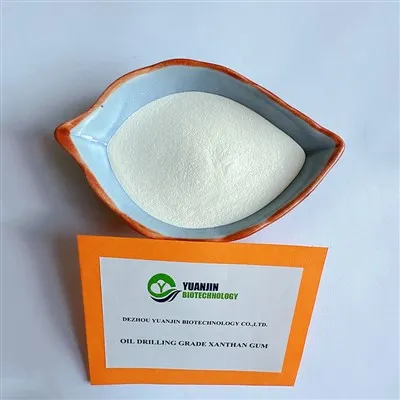
Hey there, drilling enthusiasts! As a supplier of Xanthan Gum Drilling Fluid, I've seen firsthand how this amazing substance plays a crucial role in well cementing operations related to drilling fluid. Today, I'm gonna dive into how xanthan gum interacts with cement slurries during these operations.
Well cementing is a vital step in the drilling process. It's all about filling the annular space between the casing and the wellbore with cement slurry. This not only provides zonal isolation but also protects the casing from corrosion and other environmental factors. And that's where xanthan gum comes in.
Xanthan gum is a polysaccharide that's produced through fermentation. It has some really unique properties that make it super useful in the oil and gas industry. One of the key things about xanthan gum is its ability to thicken and stabilize fluids. When it's added to a cement slurry, it can have a big impact on the slurry's rheology and performance.
Let's start by talking about how xanthan gum affects the viscosity of cement slurries. Viscosity is basically a measure of a fluid's resistance to flow. In the context of cement slurries, having the right viscosity is crucial. If the slurry is too thin, it might not be able to hold the cement particles in suspension, which could lead to settling and a non - uniform cement job. On the other hand, if it's too thick, it can be difficult to pump the slurry down the wellbore.
Xanthan gum acts as a thickening agent in cement slurries. When it's added to the slurry, it forms a network structure that entraps water molecules. This network increases the apparent viscosity of the slurry, making it more resistant to flow. This is particularly important during the pumping stage of well cementing. The increased viscosity helps to prevent the slurry from flowing too quickly and ensures that it can be placed evenly in the annular space. You can learn more about the Xanthan Gum Oil Drilling Grade that we offer, which is specifically designed for these high - performance applications.
Another important property that xanthan gum imparts to cement slurries is thixotropy. Thixotropy is the ability of a fluid to become less viscous when it's subjected to shear stress (like when it's being pumped) and then return to its original, more viscous state when the shear stress is removed. This is a really handy property for well cementing.
During the pumping process, the high shear stress associated with the flow of the slurry through the pipes and into the wellbore causes the xanthan gum network to break down temporarily. As a result, the viscosity of the slurry decreases, making it easier to pump. Once the slurry is in place and the pumping stops, the network reforms, and the viscosity increases again. This helps the slurry to stay in place and prevent it from flowing out of the annular space before it has a chance to set. Our Xanthan Gum For Drilling is formulated to provide excellent thixotropic properties.
In addition to its effects on viscosity and thixotropy, xanthan gum also has an impact on the filtration properties of cement slurries. Filtration is the process by which the liquid phase of the slurry seeps into the surrounding rock formation. This can be a problem because it can cause the slurry to lose water, which can lead to changes in the slurry's properties and even affect the integrity of the cement job.
Xanthan gum helps to reduce filtration by forming a thin, protective film on the surface of the wellbore. This film acts as a barrier that prevents the liquid phase of the slurry from escaping into the formation. As a result, the slurry retains its water content, and its properties remain more stable during the well cementing process. Our Xanthan Gum Drilling Fluid is carefully engineered to optimize the filtration control of cement slurries.
The interaction between xanthan gum and cement slurries also has an influence on the setting time of the cement. The setting time is the amount of time it takes for the cement to change from a fluid state to a solid state. It's important to have precise control over the setting time to ensure that the cement has enough time to be placed properly but also sets quickly enough to provide the necessary support.
Xanthan gum can have a retarding effect on the setting time of cement slurries. This is because it can interact with the cement particles and slow down the chemical reactions that lead to the formation of the cement matrix. This retarding effect can be beneficial in some situations. For example, in deep wells where the pumping time is long, a longer setting time can prevent the cement from setting before it reaches its final position.
However, it's important to note that the amount of xanthan gum added to the slurry needs to be carefully controlled. Too much xanthan gum can cause excessive retardation, which can delay the completion of the well cementing operation and increase costs. On the other hand, too little xanthan gum may not provide the desired effects on viscosity, thixotropy, filtration, and setting time.
So, how do we determine the right amount of xanthan gum to use in a cement slurry? Well, it depends on a variety of factors, including the specific requirements of the well, the type of cement being used, and the properties of the drilling fluid. Our team of experts is always available to help you figure out the optimal dosage of xanthan gum for your particular application. We've got years of experience in the field, and we've worked on a wide range of well cementing projects.
If you're in the market for high - quality xanthan gum products for your drilling fluid needs, you've come to the right place. We're committed to providing our customers with the best possible products and services. Our xanthan gum is produced using state - of - the - art manufacturing processes, and it meets all the industry standards for performance and quality.
Whether you're working on a small - scale drilling project or a large - scale commercial operation, our Xanthan Gum Drilling Fluid can help you achieve better results in your well cementing operations. So, if you're interested in learning more about our products or would like to discuss your specific requirements, don't hesitate to reach out. We're here to help you take your drilling operations to the next level.


In conclusion, xanthan gum has a significant impact on the performance of cement slurries during well cementing operations. Its ability to affect viscosity, thixotropy, filtration, and setting time makes it an essential component in modern drilling fluids. As a leading supplier of Xanthan Gum Drilling Fluid, we're excited to be a part of this dynamic industry and to help our customers succeed. So, if you're looking for a reliable partner for your xanthan gum needs, contact us today and let's start a conversation about how we can work together.
References
- Smith, J. (20XX). "The Role of Polymers in Well Cementing." Drilling Technology Journal.
- Brown, A. (20XX). "Xanthan Gum: Properties and Applications in the Oil and Gas Industry." Petroleum Research Magazine.
- Green, C. (20XX). "Optimizing Cement Slurry Properties with Additives." Well Construction Review.