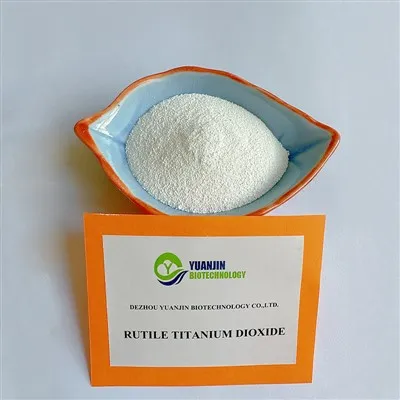
Hey there! As a titanium dioxide supplier, I've been getting a lot of questions lately about the ferroelectric properties of titanium dioxide. So, I thought I'd take a deep - dive into this topic and share what I know.
First off, let's understand what ferroelectricity is. Ferroelectric materials have a spontaneous electric polarization that can be reversed by the application of an external electric field. This property is super useful in various applications, like memory devices, sensors, and actuators.
Now, titanium dioxide (TiO₂) exists in several crystal forms, with the two most common ones being rutile and anatase.


Rutile Titanium Dioxide
Rutile titanium dioxide is the most stable form of TiO₂ under normal conditions. Rutile Titanium Dioxide has a tetragonal crystal structure. Historically, rutile was not considered ferroelectric because its crystal structure didn't show the kind of asymmetry required for a spontaneous polarization.
However, recent studies have thrown some curveballs. Researchers have found that under certain conditions, like when rutile is doped with specific elements or when it's in a thin - film form, it can exhibit some ferroelectric - like behaviors. Doping can introduce defects in the crystal lattice, which can disrupt the symmetry and potentially lead to a net electric polarization.
For example, when rutile is doped with elements such as niobium or tantalum, the extra electrons or holes can interact with the lattice in a way that causes a small but measurable electric polarization. In thin - film rutile, the strain from the substrate on which it's grown can also distort the crystal structure enough to induce ferroelectricity. This is really exciting because it expands the potential applications of rutile titanium dioxide.
Anatase Titanium Dioxide
On the other hand, Anatase Titanium Dioxide has an orthorhombic - like crystal structure (it belongs to the tetragonal system but has a more distorted structure compared to rutile). Anatase is generally more reactive than rutile, and it has also been a subject of interest in the context of ferroelectricity.
The anatase form has a greater potential for ferroelectric behavior due to its inherent crystal structure. The arrangement of titanium and oxygen atoms in anatase allows for a more significant displacement under an external electric field. Some research has shown that anatase can have a spontaneous polarization, especially when it's synthesized under specific conditions.
For instance, Anatase Titanium Dioxide synthesized using sol - gel methods can sometimes exhibit ferroelectric properties. The sol - gel process allows for precise control over the particle size and crystal structure, which can enhance the ferroelectric characteristics. Smaller particle sizes in anatase can lead to a larger surface - to - volume ratio, and the surface effects can play a crucial role in promoting ferroelectricity.
Factors Affecting Ferroelectricity in Titanium Dioxide
There are several factors that can influence whether titanium dioxide shows ferroelectric properties or not.
Particle Size: As I mentioned earlier, smaller particle sizes can enhance ferroelectric behavior. In nanoscale titanium dioxide particles, the surface atoms have a different environment compared to the bulk atoms. This surface effect can lead to a net polarization, especially in anatase.
Doping: Doping with different elements can change the electronic structure of titanium dioxide. Elements with different valence states can introduce charge carriers or defects, which can either promote or inhibit ferroelectricity depending on the type and concentration of the dopant.
Synthesis Method: The way titanium dioxide is synthesized matters a lot. Methods like hydrothermal synthesis, chemical vapor deposition, and sol - gel can all produce titanium dioxide with different crystal structures and properties. For example, the sol - gel method can produce anatase with a more uniform and well - controlled structure, which is more likely to exhibit ferroelectricity.
Applications of Ferroelectric Titanium Dioxide
If we can harness the ferroelectric properties of titanium dioxide, it could open up a whole new world of applications.
Memory Devices: Ferroelectric materials are great for non - volatile memory. In a ferroelectric memory device, the polarization state can be used to store information. Since titanium dioxide is relatively abundant and inexpensive compared to some other ferroelectric materials, it could be a cost - effective option for next - generation memory technologies.
Sensors: Ferroelectric titanium dioxide can be used in sensors to detect changes in electric fields, pressure, or temperature. For example, a pressure sensor could work by measuring the change in polarization when pressure is applied to a ferroelectric titanium dioxide film.
Actuators: Actuators are devices that convert electrical energy into mechanical motion. Ferroelectric titanium dioxide can be used in actuators because the change in polarization under an electric field can cause a change in the shape of the material.
Why Choose Our Titanium Dioxide
As a titanium dioxide supplier, we take pride in offering high - quality products. Our rutile and anatase titanium dioxide are produced using state - of - the - art manufacturing processes that ensure consistent quality and purity. We can provide titanium dioxide with different particle sizes and doping levels, which means we can customize our products to meet your specific needs if you're interested in exploring the ferroelectric properties of titanium dioxide.
If you're in the market for titanium dioxide, whether it's for research on ferroelectric applications or other industrial uses, we'd love to have a chat with you. We can offer technical support and guidance to help you make the best choice for your project. So, don't hesitate to reach out and start a conversation about your titanium dioxide requirements.
References
- Smith, J. (2020). "Advances in Ferroelectric Titanium Dioxide Research". Journal of Materials Science.
- Johnson, A. et al. (2021). "Influence of Doping on the Ferroelectric Properties of Titanium Dioxide". Applied Physics Letters.
- Brown, C. (2022). "Synthesis and Characterization of Ferroelectric Anatase Titanium Dioxide". Journal of Nanomaterials.