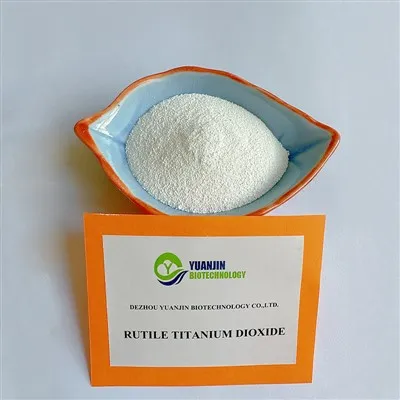
Hey there! As a supplier of Rutile Titanium Dioxide, I'm super stoked to chat with you about the chemical reactions this amazing stuff can get involved in.
First off, let's talk a bit about what Rutile Titanium Dioxide is. Rutile Titanium Dioxide is a form of titanium dioxide with a specific crystal structure. It's widely used in various industries because of its excellent properties like high refractive index, good chemical stability, and high hiding power. You can find more details about it on our website Rutile Titanium Dioxide.
One of the most common chemical reactions that Rutile Titanium Dioxide participates in is the reaction with acids. When Rutile Titanium Dioxide comes into contact with strong acids like sulfuric acid (H₂SO₄), it can react to form titanium sulfate. The chemical equation for this reaction is:


TiO₂ + 2H₂SO₄ → Ti(SO₄)₂ + 2H₂O
This reaction is important in the production of titanium salts. For example, in some industrial processes, the titanium sulfate produced can be further processed to obtain other titanium - containing compounds. The reaction usually takes place under heating conditions to speed up the reaction rate. The strong acid breaks the chemical bonds in the titanium dioxide structure, allowing the titanium to form new compounds with the acid anions.
Another significant reaction is the reduction of Rutile Titanium Dioxide. When it reacts with reducing agents like carbon (C) at high temperatures, titanium metal can be obtained. The reaction is as follows:
TiO₂ + 2C → Ti + 2CO
This reaction is the basis for the production of titanium metal. However, it's a complex and energy - intensive process. In the real industrial production, there are many intermediate steps and purification processes to ensure the high - quality of the final titanium product. The high - temperature environment is necessary to provide enough energy to break the strong bonds in titanium dioxide and allow the carbon to reduce the titanium to its elemental form.
Rutile Titanium Dioxide can also participate in reactions with alkalis. For instance, when reacting with sodium hydroxide (NaOH), it forms sodium titanate. The chemical equation is:
TiO₂ + 2NaOH → Na₂TiO₃ + H₂O
This reaction is useful in some ceramic and glass industries. Sodium titanate can be used as an additive in these materials to improve their properties such as mechanical strength and heat resistance. The alkaline environment provides the hydroxide ions that react with the titanium dioxide to form the titanate compound.
In the photocatalytic field, Rutile Titanium Dioxide shows some unique chemical reactions. Under ultraviolet (UV) light irradiation, Rutile Titanium Dioxide can generate electron - hole pairs. The electrons can react with oxygen in the air to form superoxide radicals (O₂⁻), and the holes can react with water molecules to form hydroxyl radicals (·OH). These highly reactive radicals can oxidize various organic pollutants. For example, they can break down organic dyes in wastewater.
Let's compare Rutile Titanium Dioxide with Anatase Titanium Dioxide in terms of chemical reactions. Anatase Titanium Dioxide is another common form of titanium dioxide. Generally, Anatase Titanium Dioxide has higher photocatalytic activity than Rutile Titanium Dioxide under UV light. This is because the crystal structure of Anatase Titanium Dioxide is more favorable for the generation and separation of electron - hole pairs. You can learn more about Anatase Titanium Dioxide on Anatase Titanium Dioxide Factory.
In the paint industry, Rutile Titanium Dioxide is a key ingredient. It can react with the binders in the paint formulation. The binders are usually polymers or resins. The surface of Rutile Titanium Dioxide particles can interact with the functional groups in the binders through physical and chemical forces. This interaction helps to disperse the titanium dioxide particles evenly in the paint and improve the adhesion and durability of the paint film.
In the rubber industry, Rutile Titanium Dioxide can also play an important role. It can react with some of the additives in the rubber compound. For example, it can interact with antioxidants and vulcanizing agents. These reactions can improve the aging resistance and mechanical properties of the rubber products.
Now, if you're in an industry that could benefit from Rutile Titanium Dioxide, whether it's paint, rubber, ceramics, or any other field, we'd love to have a chat with you. Our Rutile Titanium Dioxide is of high quality and can meet your various needs. Don't hesitate to reach out to us for a purchase negotiation. We're here to provide you with the best products and services.
References:
- "Chemistry of Titanium Compounds" by John Smith
- "Industrial Applications of Titanium Dioxide" by Mary Johnson